Dow Jones AI Summaries Platform. Designing a trust-first AI summarization system across Dow Jones products.
Confidentiality notice
This work spans active platform strategy, shared AI capabilities, and multiple product surfaces. To respect that, this case study stays intentionally high-level, focusing on the cross-brand design problem, platform principles, and reusable outcomes rather than brand-specific implementation details.
Challenge
Dow Jones had a chance to differentiate AI for business professionals, but the harder problem was making AI outputs feel trustworthy, useful, and consistent across a multi-brand portfolio spanning B2B and B2C. With Factiva AI, WSJ AI, and DJ+ AI evolving in parallel, fragmented execution risked diluting the experience. The platform needed to be grounded in editorial judgment, verifiable sourcing, and workflows people could rely on for professional decisions.
Strategy
Frame the work as a platform problem, not a feature problem. Build trust through verifiable citations and explicit grounding, design for professional research workflows rather than a detached chatbot, create reusable trust and citation patterns that scale across B2B and B2C, and push outputs beyond a generic AI blob toward structured, analytical, distinctly Dow Jones formats.
Results
Moved Dow Jones AI from isolated feature discussions toward coherent platform direction. AI-powered features began landing across products with cross-brand parity for shared chat and AI experiences on DJ+. The summary capability matured into smarter summaries, company summaries, and broader search and data inputs, and the underlying trust patterns became reusable foundations informing current and future milestones across B2B and B2C AI work.
The story
One of the most interesting parts of this work was that the design problem started above the feature level. The challenge was not only how to summarize content with AI. It was how to define what a Dow Jones AI experience should feel like across brands, products, and customer types.
That meant creating clarity where there were few established patterns. Internal strategy and design work repeatedly emphasized trust, verification, source clarity, workflow integration, and reusable direction as the foundations for AI across the portfolio. Rather than letting each product solve the same AI questions independently, I helped push toward shared foundations and patterns that multiple teams could evaluate and reuse together.
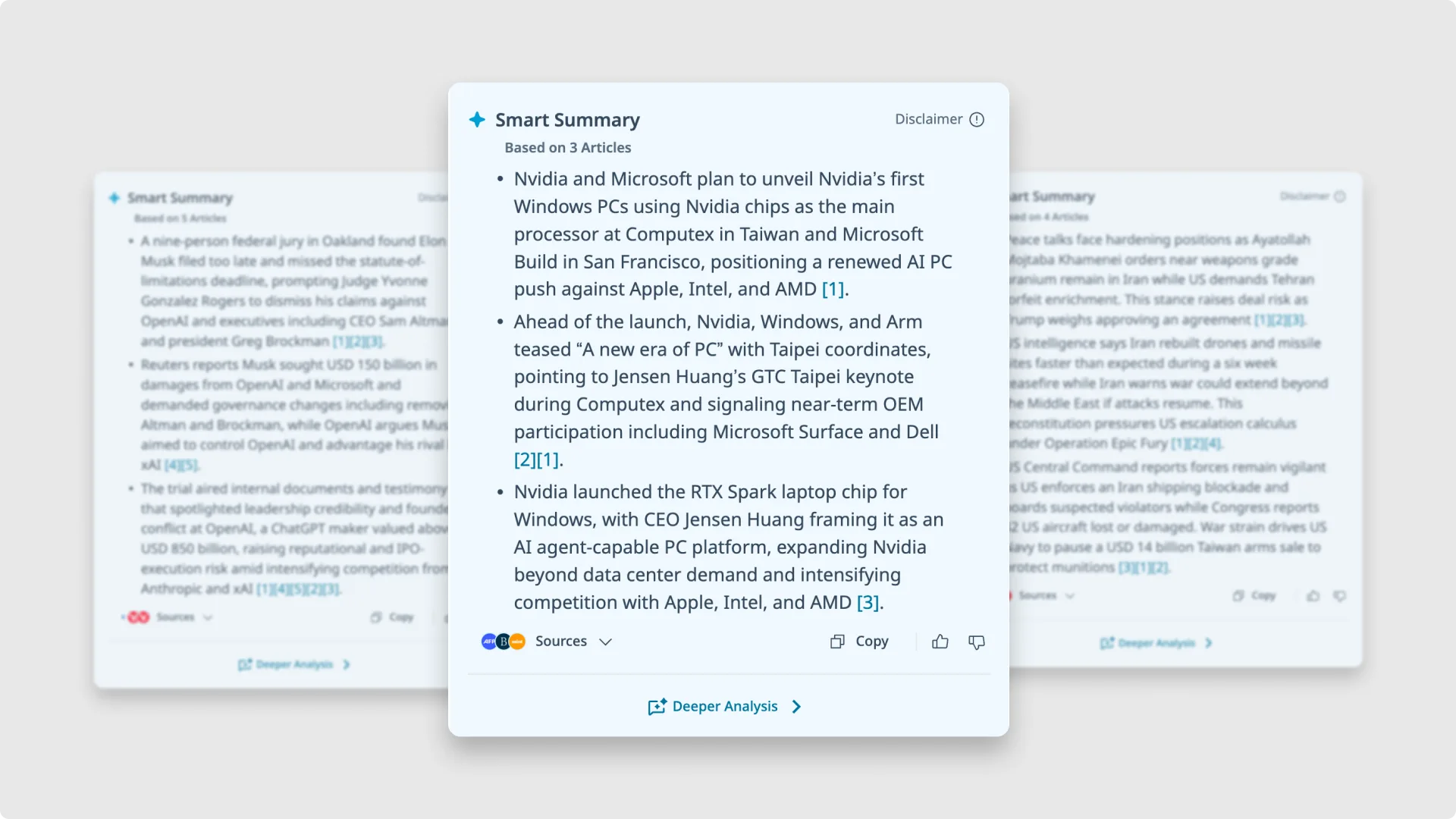
A big part of the design value was reframing trust as interface behavior. The platform strategy called for verifiable citations and contradiction flagging, while adjacent pattern work explored richer source context, unified sourcing models, and explainable relevance layers. The point was not simply to show sources. It was to reduce the verification burden on users and make AI outputs easier to inspect, trust, and act on.
Another key part of the work was defining what good AI output should look like in a Dow Jones context. The aspiration was not to produce generic chat responses, but more structured and analytical outputs that felt appropriate for research, synthesis, and decision support. That principle showed up in the roadmap through multiple summary formats, thematic briefings, and later refinements aimed at stronger editorial tone and more analytical language.
For my portfolio, this became less about one launch and more about building a reusable layer of AI design direction. The work connected strategy, UX patterns, workflow thinking, and cross-functional alignment across Search, AI, and broader Dow Jones platform efforts.
Select highlights
- Reframed AI summaries as a cross-brand platform capability, not just a single-product feature.
- Anchored the experience in trust, verifiability, and editorial judgment as core differentiators.
- Defined reusable citation and source patterns for broader Dow Jones AI work.
- Supported a roadmap with multiple summary formats, thematic briefings, and workflow-oriented AI assistance.
- Helped shape AI direction that could scale across B2B and B2C products rather than remain siloed by brand.