Dow Jones Platform AI Experience. Designing AI capabilities for one of the world's most trusted research corpora.
Confidentiality notice
This work sits inside active Dow Jones products and a shared AI system. The features named here are public; usage figures are observational and rounded, and implementation details stay out. The case study focuses on the design problem, the principles, and what shipped.
Who
Analysts, researchers, and compliance teams across the Dow Jones Platform: Factiva, Oxford Analytica, Dragonfly, Dow Jones Risk Journal, and other professional products that share the same AI capabilities.
Problem
We were the archive. The customer did the analysis. Opening the archive to a general assistant did not beat the assistant alone.
My role
Lead AI and search design. Defined the interaction model and built the prototypes on live retrieval.
Challenge
Dow Jones holds a corpus of about two billion articles from thousands of licensed sources. The question was how AI integration should mature across it: summarization, then an assistant, then reports, then monitoring, each step moving more synthesis into the product while keeping the evidence visible. The challenge was never speed. It was credibility: could an analyst put an AI answer in front of a client, or stand behind it under legal and editorial scrutiny? And the work sits at the platform level: each capability is built once and used by every brand on the Dow Jones Platform, so every decision about grounding, citation, and format had to hold across products with different readers and different stakes.
What we learned before designing
Access is not enough
Giving a general assistant the archive did not beat the assistant alone. Customers wanted finished work, not raw material.
Experts will not give up control
Advanced users trust what they can read and edit. Any translation of their intent had to stay visible.
Trust needs visible evidence
Users rejected answers they could not inspect, not AI answers as such.
The question outlives the session
The same topics were re-searched by hand, week after week.
The analyst's day, before and after
| Stage | Search | Understand | Investigate | Report | Monitor |
|---|---|---|---|---|---|
| Doing | Writes and refines Boolean queries | Scans results, opens articles | Compares sources, asks colleagues | Rewrites findings into the house format | Re-runs the same searches weekly |
| Pain | Syntax is hard to learn | No orientation before reading | Trail gets lost between tabs | Hours of manual synthesis | Change is noticed late, or missed |
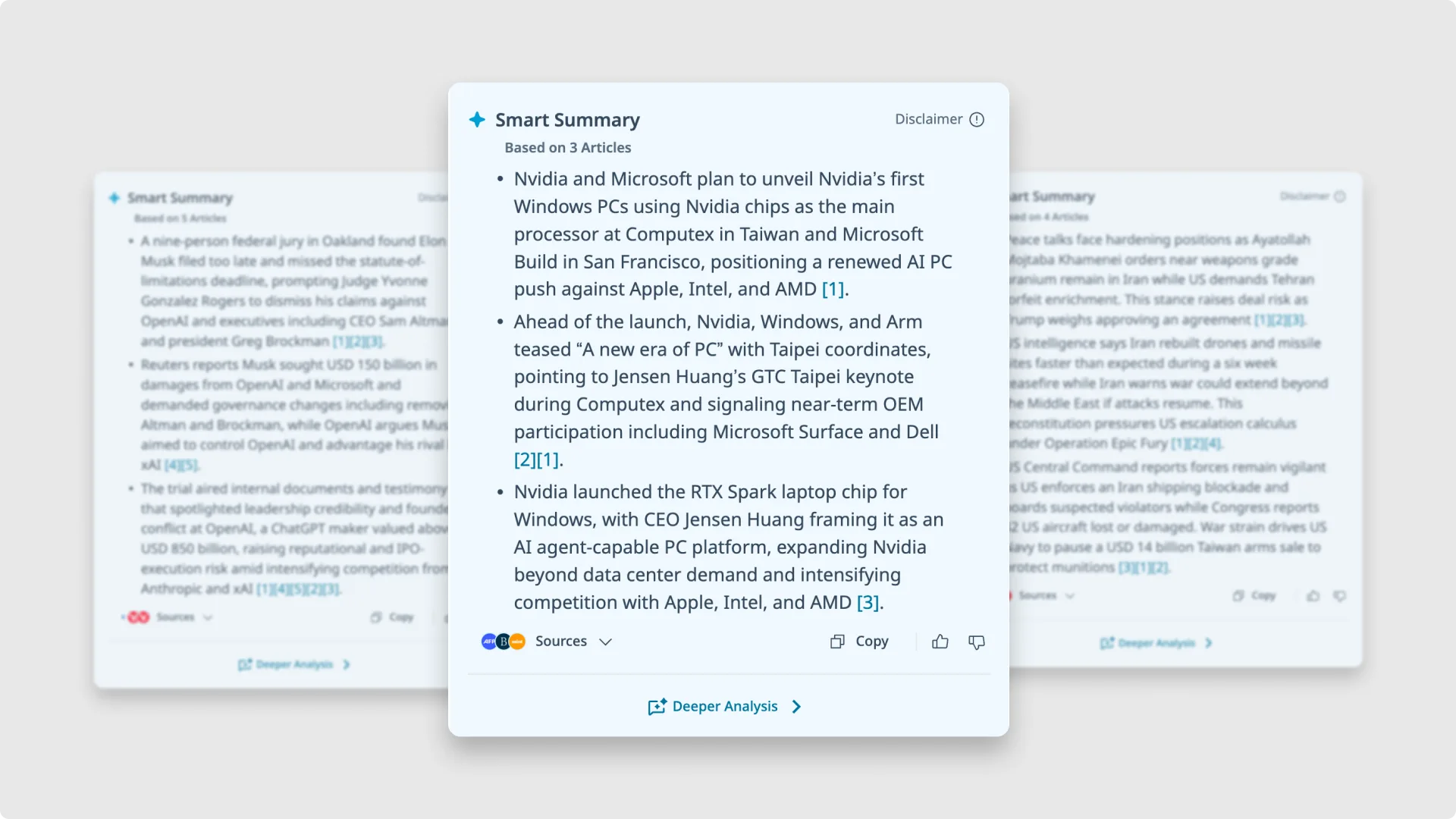
| What we built | Natural-language hybrid search, with optional translation to Boolean | Smart Summary: three cited bullets | AI Assistant: sources first, follow-ups | Smart Report: AI-generated from expert templates | Smart Alerts: baseline, delta, paused |
Strategy
Build the four capabilities in sequence, and hold them all to one standard of evidence. Every answer cites the document it came from. Sources appear before the answer is written, so checking a claim never depends on the reader's patience. A Smart Report is AI-generated, but it follows a template an expert defined, so its structure carries that expert's judgment rather than the model's. An alert is a question the analyst asked once and kept running, so their intent outlives the session. Different products, one rule: the reader can always see where a claim came from and step into the source.
Frame it as a platform problem, not a feature problem: build each capability once for every brand on the platform, embed the assistant inside the product rather than a separate destination, ground every answer in licensed content rather than the open web, build reusable trust and citation patterns that scale across B2B and B2C, and shape outputs as structured, analytical formats rather than a generic AI response.
What we built
- 01
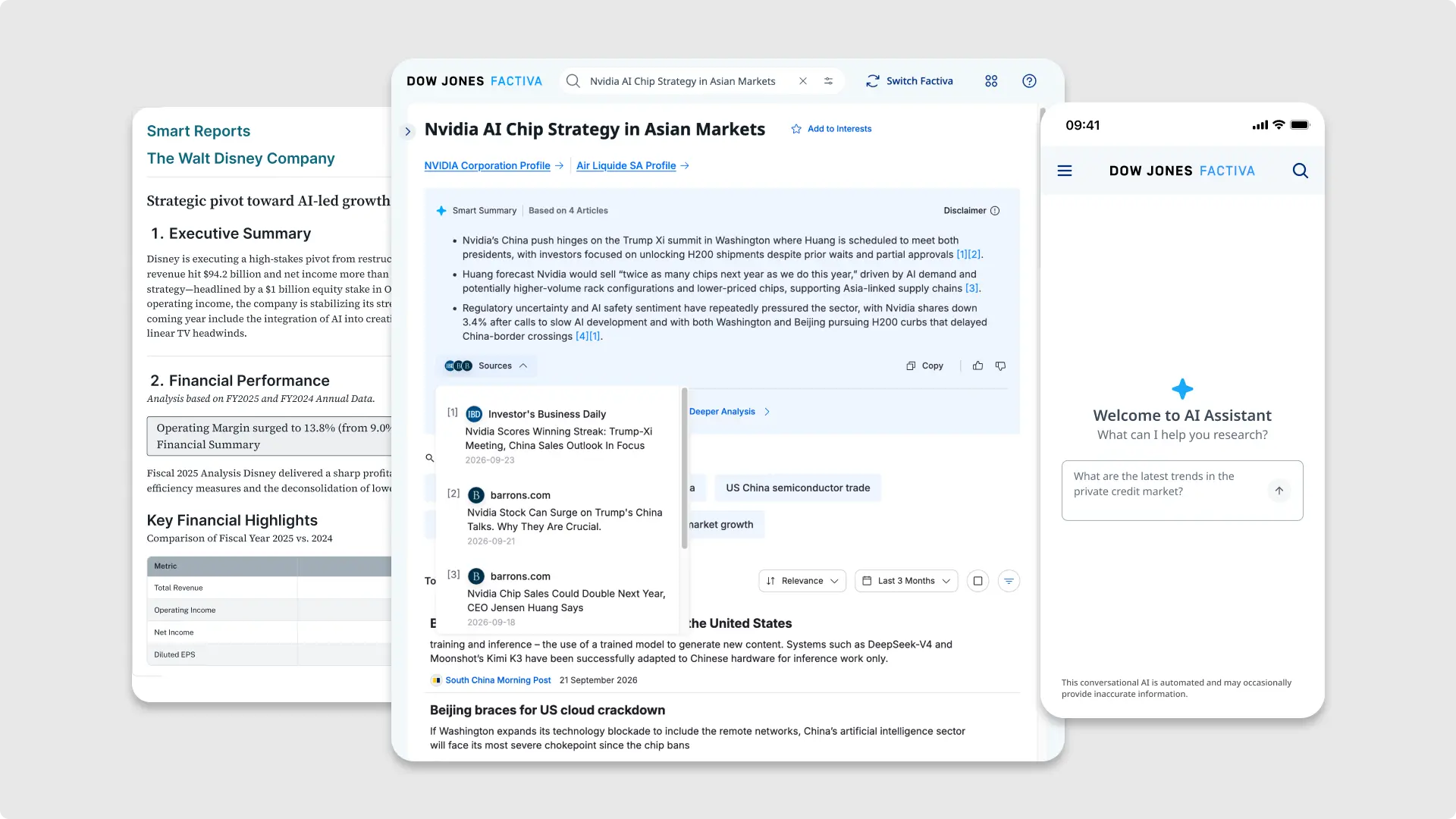
Smart Summary
Three cited bullets above the results, so the reader is oriented before opening anything.
Shipped - 02
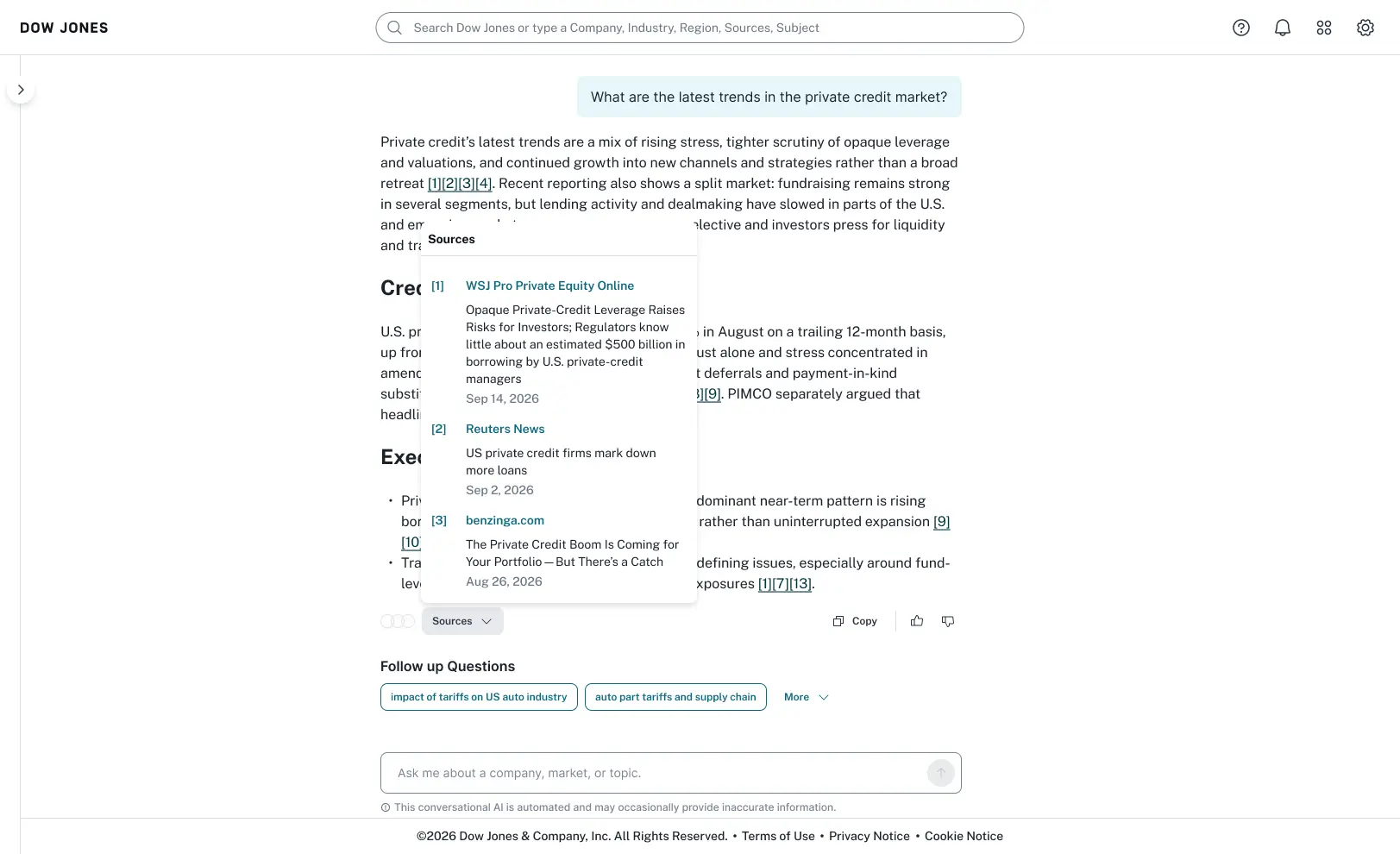
AI Assistant
Grounded answers with sources first and follow-ups alongside the answer, inside New Factiva.
Shipped - 03
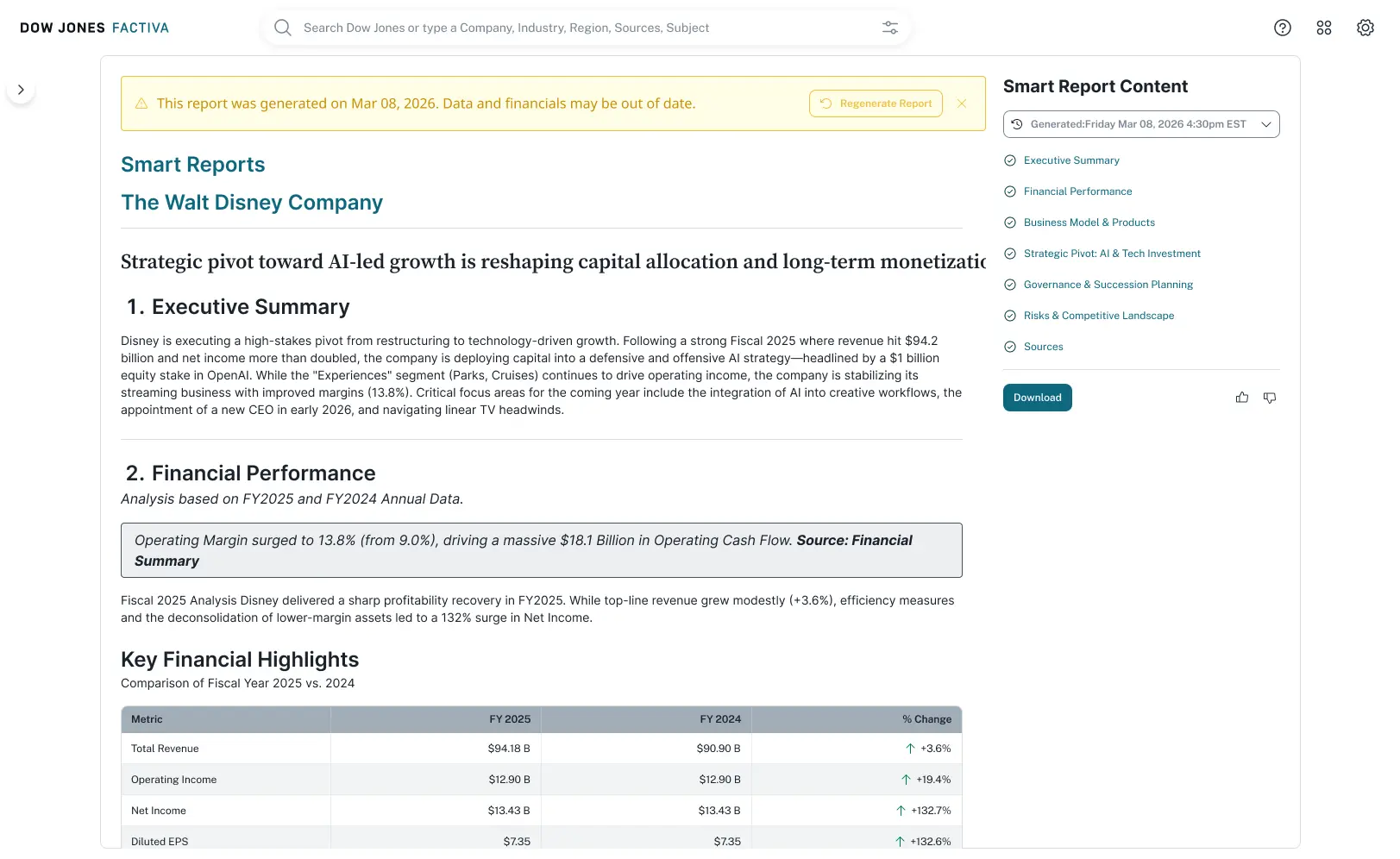
Smart Report
An AI-generated report on an expert-defined framework, filled from live licensed sources. The template carries the analyst's judgment.
Shipped - 04
Smart Alerts
A question plus a frequency. Returns the delta against a baseline, and can be paused.
Shipping this quarter
Results
Launched inside New Factiva as a major AI release, with automatic access for every Factiva account and no extra entitlement or setup. Observed among exposed users: two-thirds start a conversation; about 2,500 users and 5,700 threads a quarter; 12% of Smart Reports are downloaded or copied; week-one AI users return at 34% versus 23%. Observational, not causal.
Because the capabilities live at the platform level, the same summaries, assistant, reports, and alerts serve Factiva, Oxford Analytica, Dragonfly, Dow Jones Risk Journal, and other brands, and the trust patterns became the reference for shared chat and AI experiences across the DJ Platform. The summary capability matured into company summaries and broader search and data inputs. The work moved Dow Jones AI from isolated feature discussions toward one platform direction.
The story
The design problem started above the feature level. The question was not "how do we add chat?" but what a Dow Jones AI experience should feel like for professional research when the same capabilities serve Factiva, Oxford Analytica, Dragonfly, and Dow Jones Risk Journal, and the value of every one of them is licensed, trusted information used in high-stakes work.
The answer was to treat trust as interface behaviour, not a marketing claim. The assistant was embedded directly in New Factiva rather than positioned as a side tool. Every answer was grounded in licensed content and traceable to its source, with sources arriving before the answer so verification never depended on the reader's patience. Small details carried a lot of that weight: placeholder text, return-state messaging, and naming consistency all told users what kind of AI this was and what they could rely on it for.
A recurring temptation was to make the assistant feel "magical" at the expense of clarity. For professional users, trust comes from constraints that are visible and understandable. So the outputs were shaped as structured, analytical formats rather than a generic response: a summary is three cited bullets, a report follows a template an expert defined, an alert is a question the analyst asked once, carried forward in time. Each step in the sequence gave the product more of the synthesis and kept the evidence in view.
The last outcome was the one that mattered most for the portfolio: the patterns did not stay in one product. Later initiatives referenced the assistant's styles and behaviours for consistency, and other teams used it as the model for shared chat layouts. The project defined what trustworthy AI interaction looks like across the Dow Jones Platform, not just inside Factiva.
Select highlights
- Led AI and search design for a four-step maturity path: Smart Summary, AI Assistant, Smart Report, Smart Alerts.
- Defined the interaction model and built the prototypes on live retrieval, so decisions were made against real answers, not mock-ups.
- Made evidence the standard: every answer cites its document and sources stream before the answer.
- Embedded the assistant inside New Factiva with automatic access for every account, no separate destination to learn.
- Shaped outputs as structured, analytical formats: cited bullets, expert templates, deltas against a baseline.
- Built the capabilities once, at platform level, so Factiva, Oxford Analytica, Dragonfly, Dow Jones Risk Journal, and other brands share one AI experience and one set of trust patterns.