Factiva AI Assistant. Building a trust-first AI research experience.
Confidentiality notice
This work sits inside an active Dow Jones product and AI system. To respect product confidentiality, this case study stays intentionally high-level, focusing on strategy, design approach, and shareable outcomes rather than sensitive implementation details.
Challenge
The challenge wasn't speed, it was credibility. Factiva users needed faster answers about companies, industries, and the news, but only if those answers carried trust and source clarity. Could users put an AI response in front of a client, or stand behind it under legal and editorial scrutiny?
Strategy
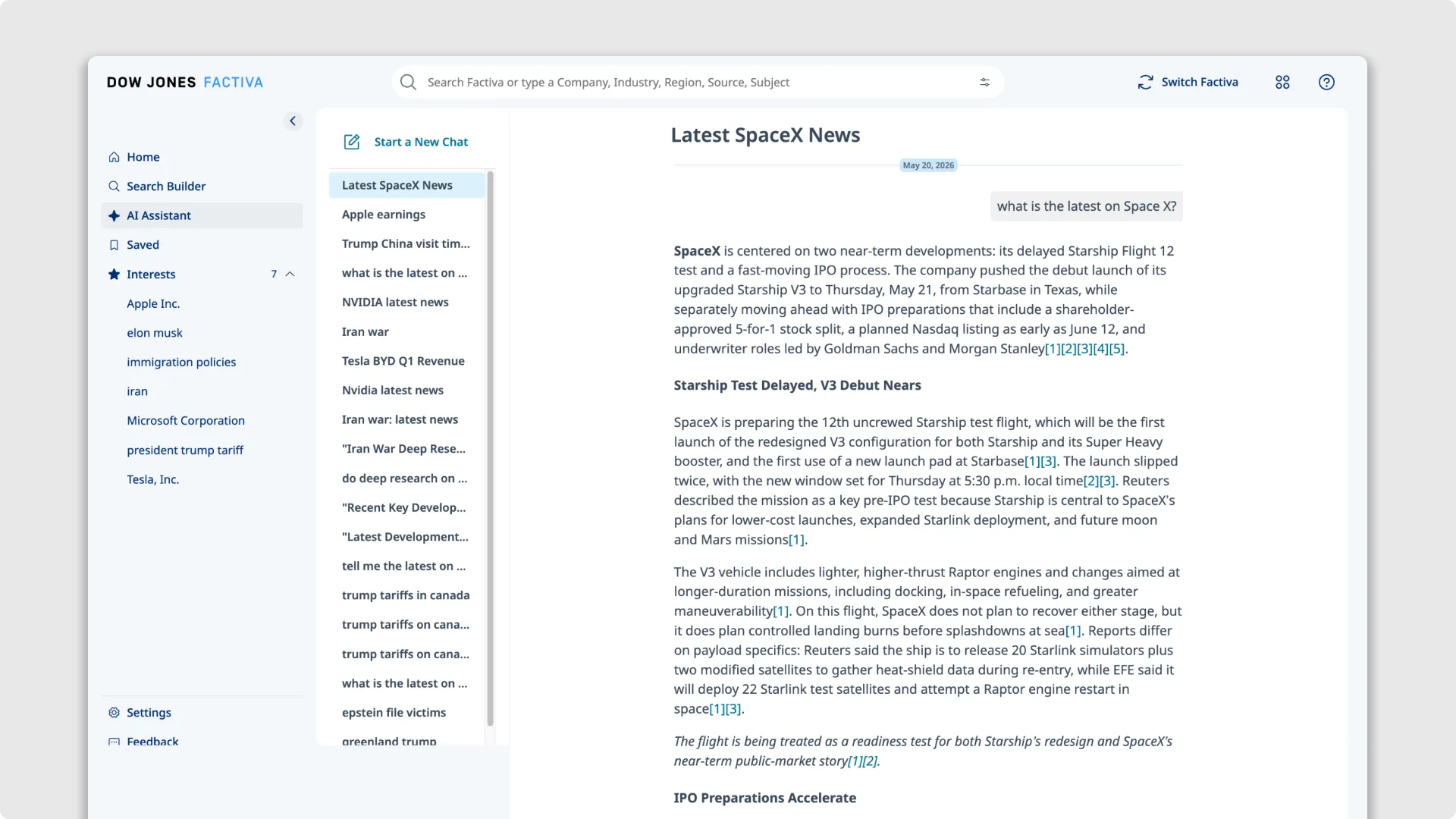
Treat trust as a product behavior, not a marketing claim. Embed the assistant inside New Factiva, ground every answer in Factiva's licensed content rather than the open web, and keep responses traceable through source links. Design work focused on messaging consistency, status clarity, and tightening the chat layout before broader rollout.
Results
Launched broadly inside New Factiva as a major AI release, with automatic access for all Factiva accounts and no extra entitlement or setup. Early preview feedback reinforced that the product landed on the right trust and workflow principles.
The story
One of the most important design questions behind Factiva AI Assistant was not "How do we add chat?" It was "How do we make AI feel appropriate for professional research?"
Factiva already had a strong value proposition: trusted, licensed information used in high-stakes research workflows. That meant the AI experience could not feel detached from the product, speculative in tone, or vague about where answers came from. If the experience was going to earn trust, it needed to feel like an extension of Factiva itself.
That principle shaped the product in a few important ways. First, the assistant was embedded directly into New Factiva rather than positioned as a separate destination or experimental side tool. Second, the answer model was framed around grounded responses and source visibility, so users could move from summary to verification without losing confidence in the output. Third, the language of the interface had to set the right expectations. Even small details like placeholder text, return-state messaging, and naming consistency mattered because they helped define what kind of AI this was and what users could rely on it to do.
My role sat at the intersection of product design direction, cross-functional alignment, and experience refinement. I worked closely with the broader DJ+ and Factiva teams as the product moved toward MVP and launch, helping shape AI features and get the experience ready for release. That included not only the visible interaction patterns, but also the operating details around feedback and iteration so the team could keep learning after launch.
A key part of the work was resisting the temptation to make the assistant feel "magical" at the expense of clarity. For professional users, trust often comes from constraints that are visible and understandable. Factiva AI Assistant was stronger because it was explicit about its grounding, integrated into an existing workflow, and designed to support research rather than replace judgment.
Another important outcome was that the work helped establish a stronger pattern for AI assistants across the broader product ecosystem. Later initiatives referenced Factiva AI Assistant's styles and patterns for consistency, and other teams used it as a model for shared chat behaviors and layouts. In that sense, the project was not only about shipping one feature. It also helped define what trustworthy AI interaction could look like across multiple Dow Jones experiences.
Select highlights
- Built directly into New Factiva, reducing the need for users to learn a separate tool.
- Grounded answers in Factiva's licensed content, not the open web.
- Made outputs traceable through source links.
- Shaped through private preview feedback before broader rollout.
- Launched with automatic access for all Factiva accounts.
- Generated positive early customer feedback after release.