Growth Design Guidelines & Operating System. A domain framework that became a blueprint for other teams.
Confidentiality notice
This work involves internal systems, team operations, and portfolio practices. To respect that, this case study stays intentionally high-level, focusing on the leadership problem, the system I created for Growth, and how that model became a template for other domains.
Challenge
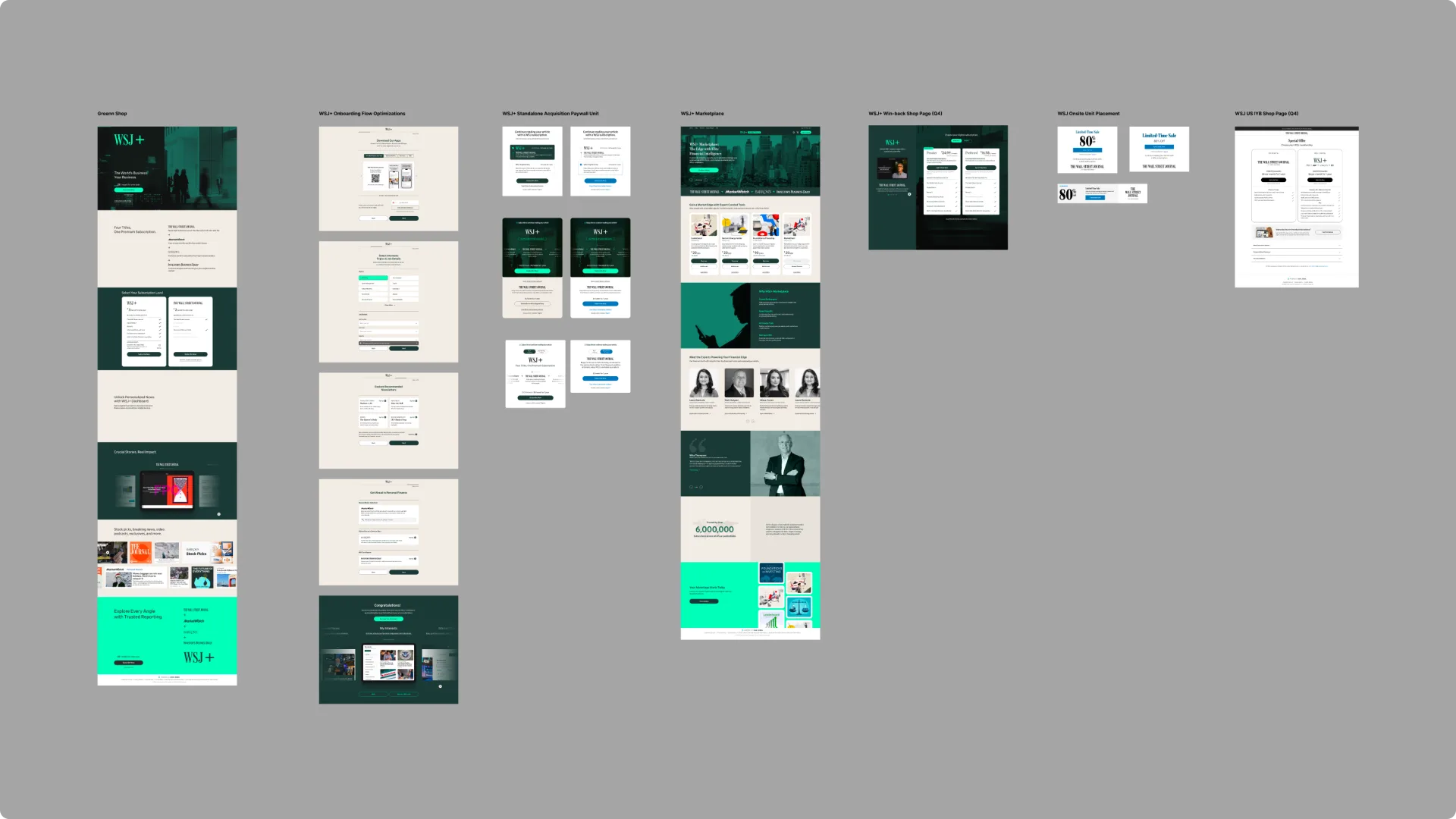
Growth work spanned acquisition, evaluation, purchase, onboarding, upsell, and win-back across multiple brands, but the team still relied on custom patterns, scattered files, and inconsistent reviews. Teams reinvented solutions, Brand and Marketing feedback often arrived too late, and there was no shared rule set for when to use the system as-is, when to extend it, and when a custom solution was actually justified. The real challenge was bigger than documentation: build something that increased consistency, reduced rework, and let the team make better decisions without needing leadership intervention on every pattern choice.
Strategy
Approach the work as both a design system problem and an operating system problem. On the design side: domain-specific guidelines built on top of Index, our cross-brand design system, with a pattern library, anti-patterns, an issues register, Index usage rules, and a performance dataset that tied recurring patterns to outcomes. Make the rules enforceable through a practical decision model: Index as-is, documented variant, true gap that should become a contribution, or genuine exception. On the operating side: standardized review phases, design-freeze logic, documentation norms, and a shared source of truth that designers, engineers, PMs, and Brand-Marketing partners could all use.
Results
A stronger, more scalable foundation for Growth work: clearer pattern library, clearer operating rules, and a more consistent way to connect design decisions to performance. The bigger result was that the work stopped being "Growth documentation" and became an organizational framework, explicitly positioned as a blueprint for Search, AI, and Editorial to systematize their own practice.
The story
The most important shift in this work was reframing Growth design from a series of projects into a system. Before that shift, too much of the team's effort was spent debating patterns, recreating known solutions, or resolving inconsistencies late in the process.
So I built the guidelines to function like a true domain system, not a slide deck of opinions. The structure was deliberate: audit the portfolio, gather evidence, extract and name patterns, document anti-patterns, identify systemic issues, map high-impact patterns to Index, and connect those choices back to outcomes.
That made the work useful in two ways. First, it gave the Growth team a practical decision framework they could apply day to day. Second, it turned local knowledge into portable knowledge. Because the system documented not only what patterns existed, but when to use them, when not to use them, and what results they were associated with, it became a model other teams could learn from rather than start over from scratch.
I also wanted the operating system around the work to be as intentional as the components themselves. Good design systems fail when the surrounding process is messy, so I focused on review sequencing, ownership clarity, documentation expectations, and handoff discipline alongside the guidelines themselves.
This became a useful pattern for my broader leadership approach: build the domain-specific system first, make the rules and procedures clear enough to reduce dependency, then use that domain model as a framework others can adapt across the portfolio.
Select highlights
- Created a Growth-specific design system that extended Index for subscription and commerce workflows rather than relying on generic system guidance alone.
- Defined a practical decision model: Index as-is, variant, gap, or exception.
- Built the system around patterns, anti-patterns, issues, evidence, and performance learnings, not just UI components.
- Paired the guidelines with an operating model: review cadence, handoff discipline, documentation standards, and shared source-of-truth assets.
- Turned a domain solution into a framework later referenced as a blueprint for Search and AI.